
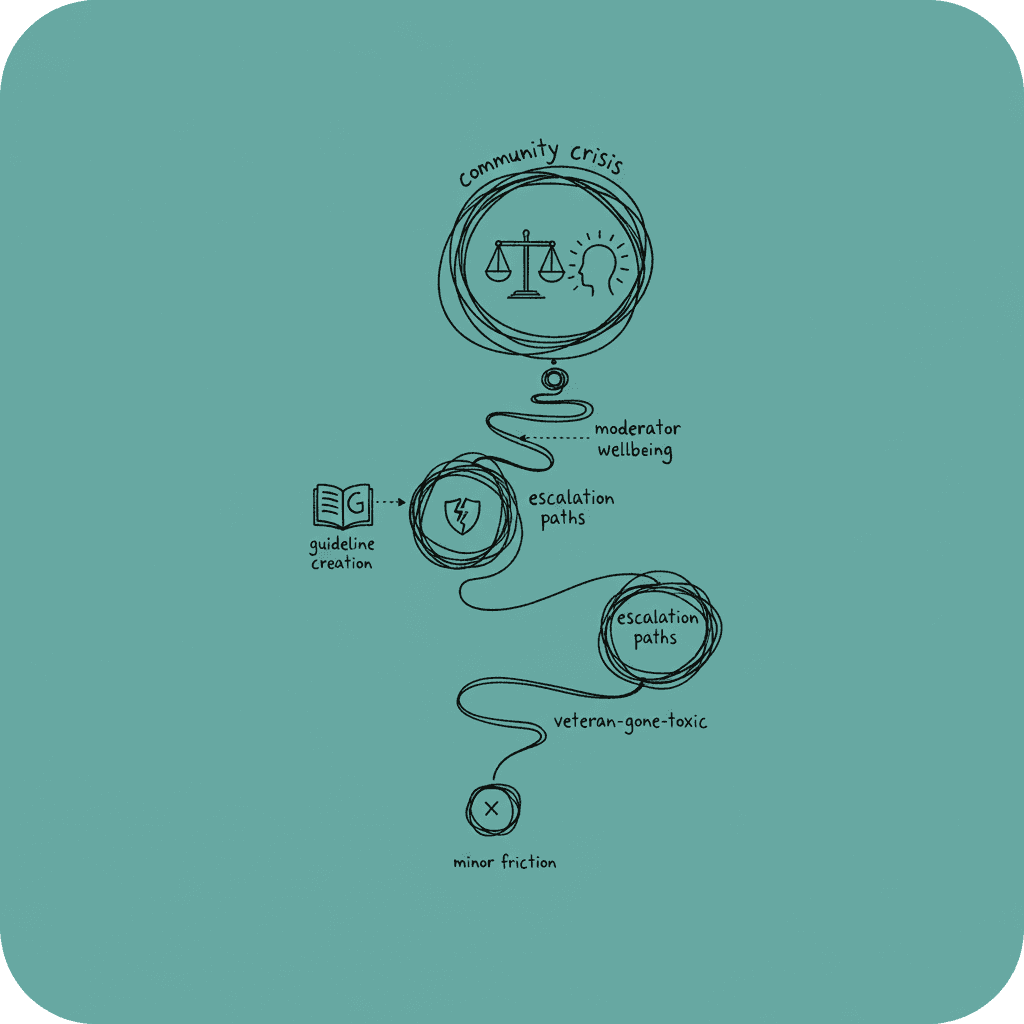
## Why Moderation Frameworks Matter
Most communities don't have a moderation problem -- they have a "we never planned for this" problem. When a conflict erupts, the response is improvised: whoever's online makes a judgment call, hopes for the best, and writes a post-hoc justification if anyone complains.
This works when your community is small. It falls apart completely at scale. CMX's 2025 report found that 33% of communities with 100,000+ members have just 2-4 moderators. That's not a team -- it's a handful of people making high-stakes decisions with no shared framework.
What follows is a moderation playbook drawn from Patrick O'Keefe's "Managing Online Forums," Khoros's 11 best practices for community moderation, Bettermode's 5-step framework, and the lived experience of community managers who've navigated everything from minor friction to full-blown crises.
## Level 1: Prevention (Before Anything Happens)
The best moderation is the kind you never have to do.
### Guidelines That Work
Your community guidelines should be specific enough to enforce and short enough to read. Most guidelines fail on one of these axes: they're either so vague that anything goes ("be respectful") or so detailed that nobody reads them.
Effective guidelines share three characteristics:
- **Behavioral, not attitudinal.** "Don't post personal attacks" is enforceable. "Be positive" is not. You can observe behavior; you can't police attitudes.
- **Illustrated with examples.** For every rule, include a concrete example of what violates it. "We don't allow personal attacks. Example: 'You clearly don't know what you're talking about' targets the person, not the idea."
- **Clear on consequences.** Members should know what happens at each stage: warning, temporary restriction, permanent ban. Ambiguity breeds both anxiety and boundary-testing.
### Setting the Tone
Patrick O'Keefe emphasizes that community tone is established by the first 50 interactions, not the first 50 rules. How founders and early members engage with each other sets the standard for everyone who follows. If early members are snarky, new members will be snarky. If early members are thoughtful, that becomes the norm.
This is why seeding your community with high-quality early conversations matters more than writing the perfect guidelines document.
## Level 2: Minor Friction (Daily Occurrences)
These are the routine interventions: off-topic posts, mild rudeness, unintentional guideline violations by well-meaning members.
### The Redirection Approach
For minor issues, redirect rather than reprimand:
- **Public redirection** (for off-topic posts): "Great question! This would get better answers in #channel-name. I'll move it there."
- **Private nudge** (for tone issues): "Hey, I noticed your reply to [member] came across a bit sharp. I know that probably wasn't your intention -- could you soften the language?"
- **Assumed positive intent**: Always start from the assumption that the person didn't realize they were causing a problem. Most of the time, this is true.
### Documentation
Even minor interventions should be logged. A single rude comment is an incident. Five rude comments over three months is a pattern. You can only spot patterns if you're tracking.
## Level 3: Escalating Conflicts (Weekly Occurrences)
These are heated disagreements, repeated minor violations, and the gray zone where someone isn't technically breaking rules but is making the space worse.
### Private Before Public
Khoros's best practices and virtually every experienced moderator agree: always handle escalating conflicts privately first. Public correction embarrasses people and turns moderation into a spectacle.
**The private conversation framework:**
1. **Name the behavior** (not the person): "I've noticed several of your recent replies have a dismissive tone."
2. **Show the impact**: "Two newer members have reached out to say they felt unwelcome after reading those replies."
3. **Assume good faith**: "I don't think that was your intention."
4. **State the expectation**: "Going forward, I'd ask that you engage with ideas you disagree with by explaining your perspective rather than dismissing the other person's."
5. **Define consequences**: "If the pattern continues, we'll need to [specific next step]."
### The Gray Zone
The hardest moderation decisions involve behavior that doesn't clearly violate any rule. Condescending tone. Passive-aggressive comments. Subtle gatekeeping where experienced members make newcomers feel stupid for asking basic questions.
Bettermode's framework suggests evaluating gray-zone behavior on impact, not intent. If multiple members are reporting that someone makes the space feel unwelcoming, the impact is real regardless of the person's intent.
Consider adding an "impact over intent" principle to your guidelines: "We evaluate behavior based on its impact on other members, not the intent behind it."
## Level 4: The Veteran Gone Toxic
This is the scenario every experienced community manager dreads. A long-time, respected member starts exhibiting toxic behavior: dismissiveness toward newcomers, hostility in disagreements, or an emerging sense of entitlement and ownership over the community.
O'Keefe identifies this as one of the most damaging community dynamics because the person's history and reputation creates a shield effect -- other members hesitate to push back, and moderators feel conflicted about intervening.
### A Framework for Veteran Members
1. **Private conversation first.** Frame it as concern, not accusation: "I've noticed a shift in your engagement recently, and I wanted to check in." Sometimes the cause is external stress that has nothing to do with the community.
2. **Specific examples, not generalizations.** "In these three threads, your replies made newer members feel dismissed" is actionable. "You've been negative lately" is not.
3. **Time-limited observation period.** If the behavior continues after the conversation, set a clear timeframe: "I'll be watching for the next two weeks. If the pattern continues, we'll need to discuss a formal consequence."
4. **Equal enforcement.** Veteran members must be held to the same standards as everyone else. The moment you make an exception for someone's tenure, you've established a two-tier system that newer members will resent and eventually leave over.
5. **Be prepared for departure.** Some veteran members will leave rather than change. This is painful but often necessary. A community that loses one toxic veteran and retains ten intimidated newcomers has made the right trade.
## Level 5: Community Crises
Crises -- public blowups, mass complaints, coordinated harassment, a member sharing private information -- require a different approach entirely.
### The First 60 Minutes
- **Acknowledge the situation publicly.** Silence is interpreted as indifference or complicity. A simple "We're aware of [situation] and are addressing it" buys you time without committing to a specific action.
- **Contain the damage.** Lock threads, temporarily restrict involved accounts, remove content that violates guidelines. Speed matters more than perfection here.
- **Communicate with your mod team.** Ensure everyone knows what happened and agrees on next steps. Inconsistent moderator responses make crises worse.
### The Follow-Up
- **Transparent communication** about what happened and what actions were taken. You don't need to share every detail, but the community should understand the decision.
- **Process review.** Every crisis reveals a gap in your systems. What would have prevented this or made the response faster?
- **Moderator debrief.** Check in with your mod team. Crisis response is emotionally draining, and burnout often follows.
## Moderator Wellbeing
Moderation is emotional labor. Moderators absorb conflict, make unpopular decisions, and receive criticism for both action and inaction. Research on content moderators at platforms like Meta has documented significant psychological impacts.
At the community level, protect your moderators by:
- **Rotating difficult tasks.** Don't let one moderator handle all the tough conversations.
- **Regular check-ins.** Ask how they're doing, not just what they're doing.
- **Clear boundaries.** Moderators shouldn't feel obligated to respond 24/7.
- **Recognition.** Moderation is often thankless. Make it less so.
- **Compensation or perks** where possible. Volunteer moderators who feel valued stick around longer.
## Building an Appeals Process
Every moderation action should have an appeals path. This isn't just about fairness -- it's about legitimacy. A community where moderation decisions are final and unquestionable will eventually breed resentment.
A simple appeals process:
1. Member submits an appeal (email or form, not public)
2. A moderator who wasn't involved in the original decision reviews it
3. Decision within 48 hours, communicated privately
4. Decision is final (to prevent infinite appeals loops)
## References
- O'Keefe, P. "Managing Online Forums." AMACOM, 2008.
- Khoros. "11 Best Practices for Community Moderation." Khoros Community Resources.
- Bettermode. "The 5-Step Community Moderation Framework." Bettermode Blog.
- BuddyBoss. "Community Conflict Management: A Practical Guide." BuddyBoss Resources.
- CMX. "The 2025 Community Industry Report." CMX by Bevy.