
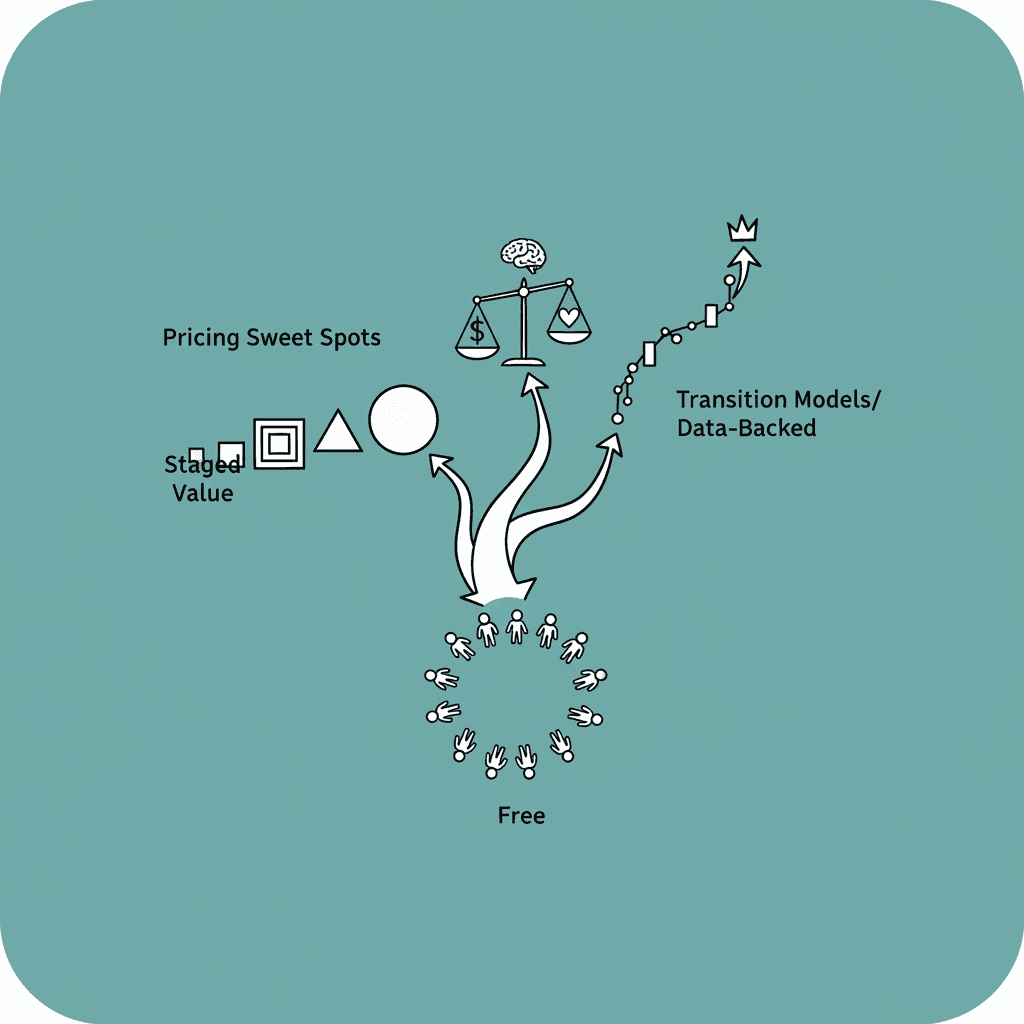
## The Fear of Charging
Every community builder who considers monetization faces the same fear: "What if I charge and everyone leaves?"
It's not an unreasonable fear. You've built something people value, and introducing money changes the dynamic. Members who tolerate rough edges in a free community become demanding customers in a paid one. The social contract shifts.
But here's what the data says: paid communities average 63% higher engagement rates than free alternatives (CMX Community Industry Report). This isn't because paying makes people more engaged -- it's because the act of paying selects for people who are genuinely committed. You lose the casual lurkers and keep the members who actually care.
The question isn't whether to charge. It's how to transition without destroying what you've built.
## Three Transition Models
### Model 1: Full Paid
Everyone pays, no free tier, no exceptions.
**When it works:** Professional communities where the value proposition is clear and the audience has a budget (developers, marketers, executives). Communities where exclusivity is part of the value.
**Expected churn:** High initially (40-60% of free members won't convert). But the members who stay are dramatically more engaged.
**The math:** If you have 1,000 free members and 5% convert at $30/month, you have 50 paying members generating $1,500/month. That's roughly in line with Mighty Networks' data showing the median paid community earns approximately $1,000/month from 26 members.
**Risk:** If your community's value depends on network effects (having a large number of people to connect with), shrinking by 95% might undermine the core proposition.
### Model 2: Freemium
Free tier with limited access, paid tier with full access.
**When it works:** Communities where the free tier can sustain itself and the paid tier offers genuinely differentiated value (exclusive content, events, direct access to experts, job boards, private groups).
**Expected churn from free:** Minimal -- free members keep their access. The challenge shifts to conversion: getting free members to see enough value in the paid tier to upgrade.
**Typical conversion rates:** 2-5% of free members converting to paid is considered good for community freemium models. Higher if the free tier actively demonstrates the paid tier's value.
**Risk:** The free tier can cannibalize the paid tier if you give away too much. Finding the right feature split is the hardest part of this model.
### Model 3: Grandfather and Gate
Existing members keep free access forever. New members pay.
**When it works:** When you can't afford to lose your existing members (they are the community) but want to monetize future growth.
**Expected churn:** Lowest of all three models -- existing members feel rewarded for being early, new members accept the price because they never had free access.
**Risk:** Grandfathered members may disengage over time if they feel like they're in a different class than paying members. And you're leaving significant revenue on the table from your most engaged users.
## The Pricing Sweet Spot
Heights Platform's research on successful paid communities identified a price clustering effect: the most successful communities charge between $26-50/month. Circle's data shows similar patterns, with $30-50/month being the range where communities report both healthy revenue and strong engagement.
Below $20/month, communities struggle to generate enough revenue to invest in quality. Above $100/month, the audience narrows to the point where growth becomes difficult.
**The psychology of pricing:**
- **$10-20/month:** "I'll try it." Low commitment, high churn. Members treat it like a subscription they might cancel.
- **$25-50/month:** "I'm investing in this." Members feel they're making a deliberate choice and are more likely to engage to justify the cost.
- **$50-100/month:** "This better deliver." Expectations are high. You need structured programming, not just access.
- **$100+/month:** "This is a business expense." Only works for communities with demonstrable professional ROI.
## Staged Value Introduction
The biggest mistake in free-to-paid transitions is announcing the change and hoping for the best. A staged approach reduces friction:
### Phase 1: Signal Value (4-6 Weeks Before)
Start creating premium content or experiences within the free community. Label them clearly: "Premium Workshop: [Topic]." Let members experience the paid tier's value before asking them to pay for it.
### Phase 2: Announce and Preview (2-3 Weeks Before)
Announce the paid tier with a detailed breakdown of what's included. Offer a founding member discount (typically 20-30% off) for anyone who commits before the official launch date. This creates urgency without pressure.
### Phase 3: Launch with a Grace Period (Week 1)
Activate the paywall but offer a 7-day free trial or a "first month free" promotion. This reduces the psychological barrier of the first payment.
### Phase 4: Optimize (Month 1-3)
Monitor engagement metrics obsessively. Are paying members more engaged? Are free-tier members converting? Where is the drop-off in the conversion funnel?
## The Engagement Impact
What actually happens to engagement when you start charging?
The consistent finding across CMX, Mighty Networks, and community practitioner reports is that **per-member engagement increases** even as **total volume may decrease.**
A community with 100 free members averaging 20 posts/day might become a community with 30 paid members averaging 25 posts/day. Total activity dropped slightly, but per-member engagement increased dramatically. More importantly, the quality of those interactions typically improves because everyone present has demonstrated commitment.
Don't optimize for total post volume. Optimize for engagement per member and the quality of conversations.
## When NOT to Charge
Monetization isn't right for every community:
- **If your community is under 200 members,** you probably don't have enough density for a paid model. Build the community first.
- **If your value is purely network-based** (connecting people to each other), charging shrinks the network and might destroy the value proposition.
- **If you haven't validated willingness to pay.** Survey your members. If fewer than 20% say they'd pay something, you need to build more value first.
- **If the community supports a product.** Product communities (support forums, user groups) should typically stay free because they reduce support costs and increase product retention.
## References
- CMX. "The 2025 Community Industry Report." CMX by Bevy.
- Mighty Networks. "The State of Paid Communities." Mighty Networks Research.
- Heights Platform. "How to Price Your Community." Heights Platform Blog.
- Circle. "Building a Successful Paid Community." Circle Resources.