
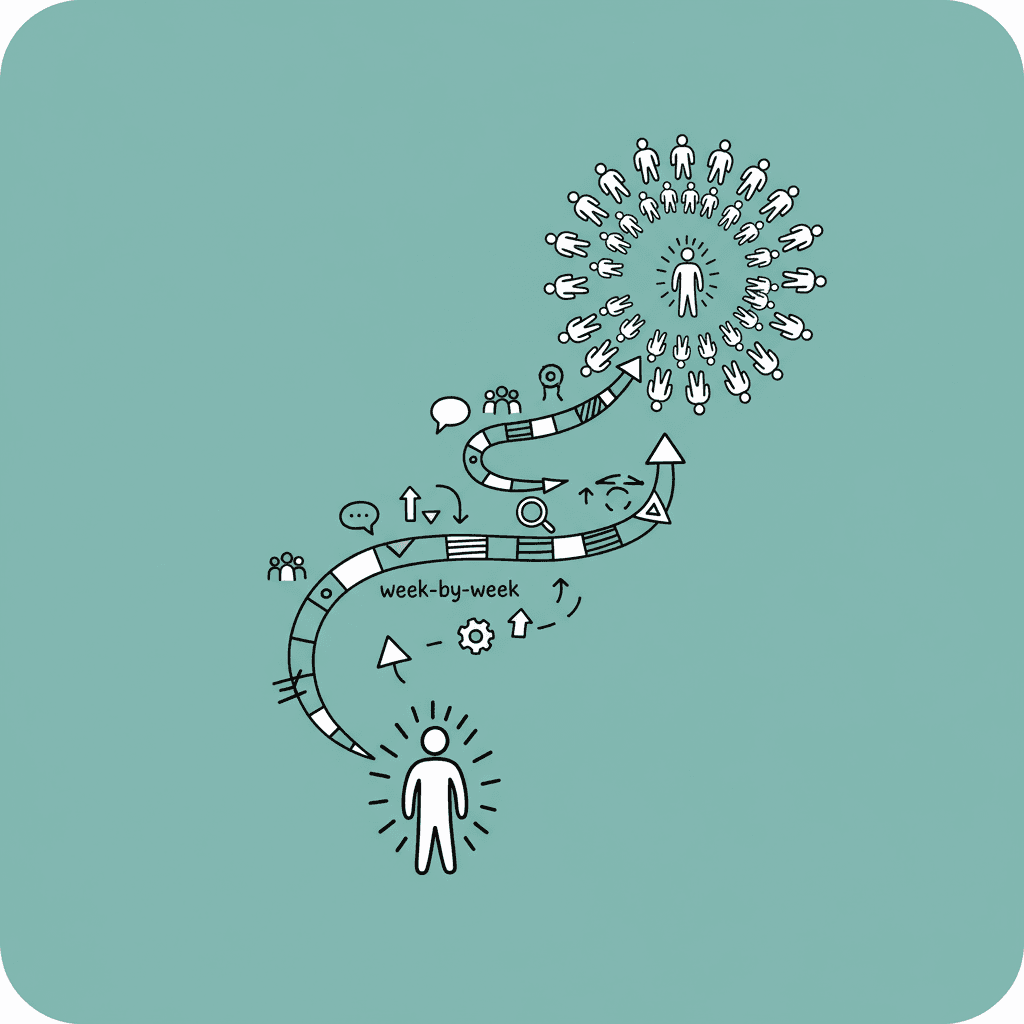
## The Cold Start Problem
Starting a community from zero is the hardest problem in community building. You're asking people to join a conversation that doesn't exist yet, in a space that has no social proof, with no guarantee that anyone else will show up.
Every community you admire went through this phase. They just don't talk about it.
This playbook covers the first 12 weeks of community building, based on "Get Together" by Bailey Richardson, Kevin Huynh, and Kai Elmer Sotto (and their spark/stoke/pass framework), Jono Bacon's Consumers/Champions/Collaborators model from "People Powered," and onboarding research from Circle and Higher Logic.
The central principle: **the founder must be the most active member** for the first 3-6 months. There are no shortcuts for this.
## Weeks 1-2: The Foundation (0-10 Members)
Your community doesn't need a platform yet. It needs people.
### Finding Your First 10
Your first 10 members should not be random people from the internet. They should be people you already have relationships with who have the exact problem your community solves.
Richardson et al. call this the "spark" phase -- finding people who already care about the thing you're building around. Not people who "might be interested" -- people who are already talking about this topic, struggling with this problem, or looking for this connection.
**How to find them:**
- Your existing professional network (former colleagues, conference contacts)
- People who've engaged with your content (blog commenters, newsletter repliers)
- Members of adjacent communities who seem underserved
- People who've directly asked you for help or advice on the topic
**How to invite them:**
Personal messages, not mass invitations. "I'm starting a community for [specific people] to discuss [specific problem]. I immediately thought of you because [specific reason]. Would you be interested in being one of the founding members?"
The specificity matters. "I'm starting a community for marketers" gets ignored. "I'm starting a community for B2B SaaS marketers who manage community programs and want to share what's actually working" gets responses.
### Week 1 Checklist
- Identify 30-50 potential founding members from your network
- Send personal invitations to 20 of them
- Set up the basic community space (keep it minimal -- you can add complexity later)
- Write and post your community's purpose statement
- Post 3-5 seed conversations that model the kind of discussion you want
### Week 2 Checklist
- Follow up with anyone who accepted but hasn't engaged
- Reply to every single post and comment (this is non-negotiable)
- Post at least once per day yourself
- Send personal invitations to 10 more people based on who accepted in Week 1
- Ask each founding member to invite one specific person they think would benefit
## Weeks 3-4: Building Rhythm (10-25 Members)
You now have a small group. The goal is to create habits.
### The Content Engine Phase
At this stage, you ARE the content engine. Jono Bacon's model describes early community members as primarily "Consumers" -- they're reading, evaluating, deciding whether this place is worth their time. Your job is to produce enough high-quality content and conversation to make the answer "yes."
**Daily posting strategy:**
- Monday: Share a resource or article with your take on it
- Tuesday: Ask a specific, answerable question
- Wednesday: Share a personal experience or lesson learned
- Thursday: Highlight or respond to something a member posted
- Friday: Pose a discussion question for the weekend
This isn't forever. But at 10-25 members, you can't rely on organic activity. You're performing community until enough members join the performance.
### Introduce a Recurring Event
Start one recurring element -- weekly thread, monthly call, regular prompt -- and commit to it. Consistency builds habits. Members start to expect and anticipate the recurring event, which creates a reason to return.
Keep it simple. A weekly "What are you working on?" thread is enough. You can get fancier later.
## Weeks 5-8: The Awkward Middle (25-50 Members)
This is the phase most communities die in.
You have enough members that it doesn't feel empty, but not enough for self-sustaining activity. Some days the community is lively; other days, nothing. You're exhausted from being the primary content creator and starting to wonder if this will ever work.
### Cultivating Champions
In Bacon's model, your first "Champions" typically emerge around the 25-50 member mark. These are members who don't just consume -- they contribute, answer questions, and start bringing their own energy.
**How to spot potential champions:**
- They respond to other members' posts (not just yours)
- They ask follow-up questions
- They share original content or experiences
- They tag or mention other members
**How to nurture them:**
- Publicly acknowledge their contributions ("Great point, @member")
- Ask them to contribute in specific ways ("You'd be perfect to lead a discussion on [topic]")
- Give them early access to new features or content
- Have a 1:1 conversation about their experience and what would make the community better
### The Critical First-48-Hours Window
Circle's onboarding research shows that members who engage within 48 hours of joining are significantly more likely to become long-term members. With 25-50 members, you can still personally welcome every new person.
**Your onboarding flow should be:**
1. Automated welcome message with clear first action ("Introduce yourself in #introductions")
2. Personal DM within 24 hours from you or a champion member
3. Tag them in a relevant existing conversation within 48 hours
4. Check-in at 7 days: did they come back?
## Weeks 9-12: Finding Momentum (50-100 Members)
At 50+ members, you should start seeing organic activity -- posts and conversations that happen without your direct initiation. If you're not, something in the earlier phases was off (wrong audience, weak value proposition, or insufficient early engagement).
### Transitioning from Performer to Director
Richardson et al. call this the "stoke" phase. You're shifting from creating all the energy yourself to amplifying energy that members bring.
**Practical shifts:**
- Post less yourself, engage more with others' posts
- Instead of starting conversations, ask champions to start them
- Create structured opportunities for members to contribute (weekly spotlights, member-led discussions, AMA sessions)
- Start saying "no" to things that only you can do and "yes" to things that members could own
### When to Stop Personally Inviting
A useful benchmark: when more than 50% of your new members are coming from organic sources (word-of-mouth, search, social sharing) rather than your personal invitations, you've achieved enough organic growth to pull back on direct outreach.
At 100 members, you should have a roughly even split between invited and organic joins. If 90% of your members still came from personal invitations, your community might have a "founder dependency" problem -- it's valuable because of you, not because of the community itself.
### Measuring Progress
Track these weekly during the first 100 members:
| Metric | Weeks 1-4 Target | Weeks 5-8 Target | Weeks 9-12 Target |
|--------|-----------------|-----------------|------------------|
| Posts per week (not by you) | 5-10 | 15-25 | 30+ |
| Members who posted this week | 3-5 | 8-15 | 15-25 |
| New member 7-day activation | 50%+ | 40%+ | 35%+ |
| Organic join rate | 0-10% | 20-30% | 40-50% |
(Activation rate drops as you get further from your personal network. This is normal.)
## The Founder Trap
The hardest part of the first 100 members isn't the tactics -- it's the emotional resilience. You'll feel like a performer in an empty room. You'll post something thoughtful and get no responses. You'll wonder if anyone cares.
This is normal. Every community you admire went through this. The founders who built thriving communities are the ones who kept showing up during the months when it felt pointless.
The work is worth doing. The first 100 members are the hardest, and everything after builds on the foundation you lay here.
## References
- Richardson, B., Huynh, K., & Sotto, K.E. "Get Together: How to Build a Community with Your People." Stripe Press, 2019.
- Bacon, J. "People Powered: How Communities Can Supercharge Your Business, Brand, and Teams." HarperCollins Leadership, 2019.
- Circle. "The Ultimate Guide to Community Onboarding." Circle Resources.
- Higher Logic. "Member Engagement Benchmarks." Higher Logic Research.
- Vogl, C. "The Art of Community." Berrett-Koehler Publishers, 2016.